Projects
30
30 tracked launches with Meraas.
Developer Profile
Meraas is a Dubai Holding-backed developer with 30 live off-plan projects across 12 active areas, concentrated in Port De La Mer, Al Wasl, Jumeirah First,
What the current data says
Developer shortlist
Need the best-fit launches from this developer?
Data coverage
We publish what our pipeline can verify today. Gaps below are on the backlog.
Projects
30
30 tracked launches with Meraas.
Areas
12
Active across 12 Dubai areas.
Price from
Price on request
Lowest tracked entry price from Meraas.
Meraas is one of Dubai's most strategically positioned developers, with 30 live off-plan projects active across 12 districts that span the city's most supply-constrained waterfront and urban-lifestyle corridors. As a Dubai Holding subsidiary since 2020, Meraas controls land in Port De La Mer, Al Wasl, Jumeirah First, City Walk, and Dubai Design District — five zones where competing supply is structurally limited and international tenant demand runs consistently above the Dubai average. Current launches start from AED 2 million at Dubai Design District, with 75/25 payment plans and handover windows from Q1 2029 through Q2 2030. For buyers comparing luxury developers in Dubai, Meraas earns selection placement on the strength of its district exclusivity, its record of delivering more than 80 million sq ft since 2007, and its January 2026 commitment to an 18-million sq ft d3 masterplan aligned directly with Dubai's D33 economic agenda.
Meraas has delivered more than 80 million sq ft of development across Dubai since its founding in 2007, with a residential output exceeding 3,500 units and a mixed-use footprint that includes Bluewaters Island, City Walk, and La Mer — three districts that were not simply built but created from scratch as new lifestyle destinations. The developer became a Dubai Holding subsidiary in 2020, consolidating government-backed financial capacity and long-term strategic alignment with the emirate's planning priorities. In 2025, Meraas ranked as Dubai's top luxury developer by average transaction value, a position driven by district exclusivity rather than unit volume.
With 30 live off-plan projects currently tracked across 12 active areas, and all 30 currently selling, Meraas operates at a scale that demonstrates institutional momentum without the dilution that affects developers releasing inventory across undifferentiated corridors. fee structures on Meraas projects run from 3% to 5%, consistent with its mid-to-luxury bracket positioning. Buyers evaluating Dubai developers on delivery credibility will find Meraas among the handful of names that have repeatedly handed over complex, multi-phase projects — including a reclaimed island in Bluewaters — without accumulating a material backlog.
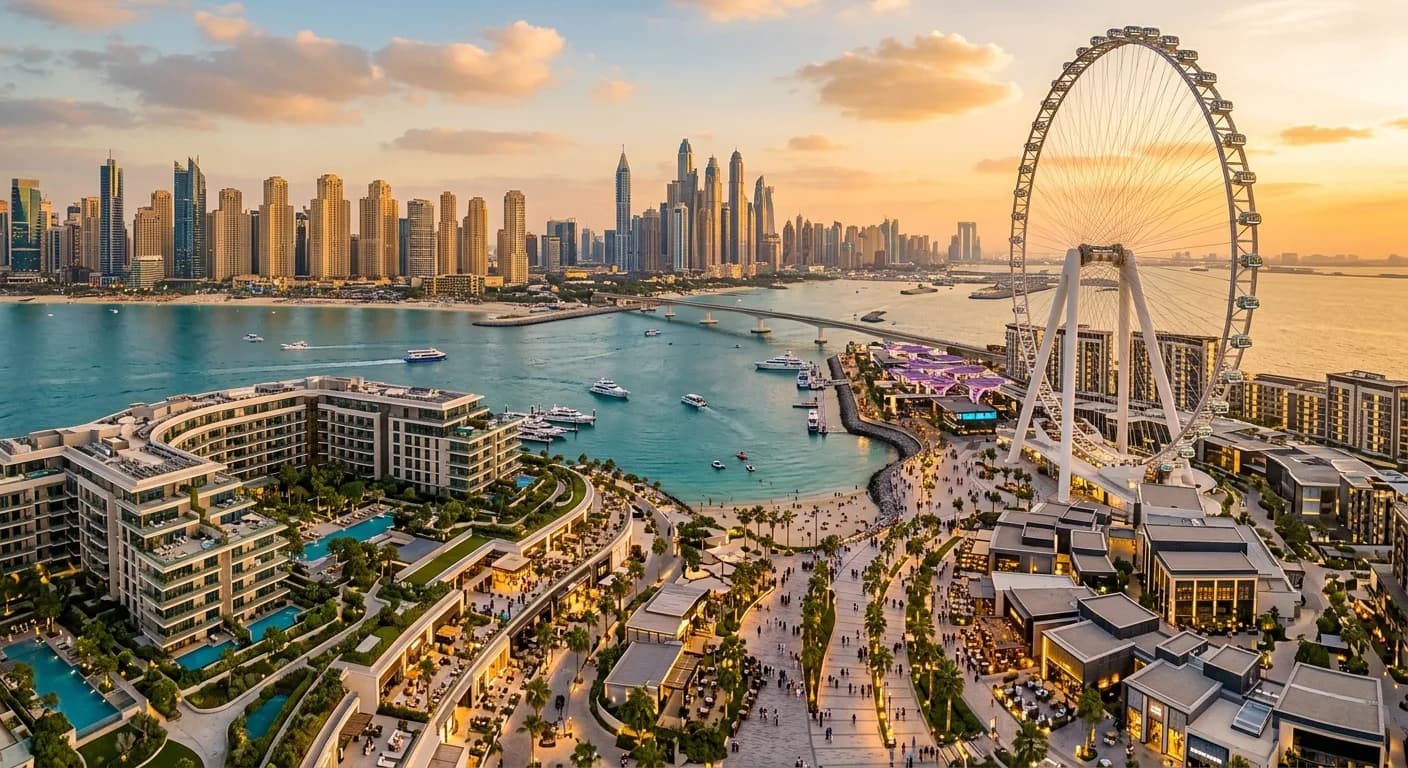
Meraas's strongest current supply concentration runs along three contiguous corridors: Port De La Mer, Al Wasl, and Jumeirah First. Port De La Mer anchors La Mer's residential offering with low-rise Mediterranean-styled buildings and direct beach access on the Jumeirah coastline. Al Wasl connects City Walk's urban mixed-use core to the Jumeirah strip, giving Meraas a rare combination of coastal and walkable-urban exposure within a single developer portfolio. Jumeirah First extends the beachfront residential corridor south toward Umm Suqeim, feeding ongoing demand from buyers who want La Mer proximity without La Mer pricing.
Beyond the coastline, City Walk delivers the developer's urban-lifestyle proposition — mixed-use towers with integrated retail that compete directly with Downtown Dubai for international tenant demand. Nad Al Sheba Gardens (Phase 9 underway) addresses mid-market villa buyers in an inland masterplan. Pearl Jumeirah and Jumeirah Bay Island carry the developer's ultra-luxury branded residential presence, with limited supply that commands pricing well above the Meraas average.
The January 2026 announcement of an 18-million sq ft masterplan for Dubai Design District is the most significant territorial expansion Meraas has made in years. Positioned between Downtown Dubai and Dubai Creek, d3's canal-front residential zones — Creekside, Design HQ, SOHO, Sanctuary, and Mindspace — will define the developer's primary supply output through 2030. This corridor has no direct equivalent in any competing developer's land bank.
Dubai Design District is carrying the highest launch volume in the current Meraas pipeline. The Edit delivers 557 apartments across three canal-facing towers with one- to four-bedroom configurations from AED 2 million, targeting handover Q2 2030 on a 75/25 payment plan — the most accessible entry point Meraas has offered in a waterfront product in recent years. Artistry One Residences adds 227 branded residences from AED 2.2 million with Q1 2029 completion. Atelis, a 280-unit waterfront tower, reached sell-out rapidly after launch, confirming that d3 demand from both local and international buyers is running ahead of supply.
At La Mer, Solaya 57 is the headline release: nine low-rise buildings designed by Foster + Partners, positioned directly on the La Mer beachfront. The architectural credibility, low-density format, and sea access place Solaya 57 in a category that justifies priority due diligence for buyers focused on capital preservation in a supply-scarce coastal setting. Jumeirah Asora Bay, also at La Mer, offers 29 ultra-exclusive residences for buyers for whom minimal supply and maximum coastal amenity take precedence over pricing.
At City Walk, City Walk Crestlane 5 and Citywalk Crestlane 4 continue the developer's urban residential push in one of Dubai's most consistently leased mixed-use corridors. For a complete view of available inventory, pricing, and payment plan terms across all 30 tracked Meraas projects, review the full Meraas project listing.
Buyers entering the Meraas pipeline in 2026 are looking at a primary handover window between Q1 2029 and Q2 2030. Artistry One Residences at d3 targets Q1 2029, The Edit targets Q2 2030, and Solaya 57 at La Mer tracks a comparable mid-to-late decade schedule. This three-to-four year off-plan cycle aligns with Meraas's recent launch cadence and gives buyers a predictable hold period for capital planning.
Historically, Meraas has not accumulated a delivery backlog of the type that has affected several mid-tier Dubai developers during peak supply cycles. The completion of Bluewaters Island — a project that required coordinating residential towers, retail, hospitality, and public infrastructure across a purpose-built reclaimed landmass — is the most demanding proof point in its delivery record. Developers that can execute at that complexity level consistently present lower completion risk than those whose track record is limited to standard apartment towers.
All Meraas off-plan projects operate under RERA registration and DLD-regulated escrow, meaning construction drawdowns are tied to verified milestone completions. The 75/25 structure on current d3 launches places the largest single payment at handover, which concentrates buyer exposure at the point of confirmed delivery rather than front-loading it during construction.
Meraas earns selection consideration through district exclusivity, not unit volume. Where Emaar delivers scale across Downtown Dubai, Dubai Creek Harbour, and Emaar Beachfront, Meraas controls waterfront and creative corridors — Port De La Mer, La Mer, City Walk, d3 — that face structural supply constraints. Land within these districts is finite and non-replicable. That scarcity has historically produced stronger price floors at resale and lower vacancy rates on rental product than volume-driven masterplanned communities where new launches can directly dilute existing inventory.
Against Nakheel, the comparison is simpler: Nakheel's strength is villa and island product on the Palm, while Meraas dominates mainland waterfront apartments with superior urban connectivity and higher amenity density. For buyers whose target tenant is an international professional rather than a family seeking villa living, Meraas outperforms Nakheel on most liquidity metrics.
The clearest competitive differentiation from Emaar is pricing tier. Emaar Creek Harbour and Emaar Beachfront can deliver lower absolute entry points in waterfront product. Meraas's AED 2 million floor at d3 is competitive for what it delivers, but La Mer and Jumeirah Bay products carry pricing that reflects scarcity and branded positioning. Buyers with AED 2 million to AED 2.5 million should evaluate d3 launches for yield-led returns; buyers above AED 3.5 million should place Solaya 57 directly alongside comparable Emaar branded product before committing.
For investors applying a policy-risk filter, Meraas's d3 masterplan is the clearest signal from any active developer that a major new supply corridor is being built to government-endorsed D33 economic objectives. That alignment reduces the regulatory and strategic risk that comes with developments positioned outside Dubai's published growth priorities.
For buyers entering between AED 2 million and AED 2.5 million, d3 offers the most compelling near-term yield case in the Meraas portfolio. The January 2026 masterplan expansion adds 18 million sq ft of canal-front residential between Downtown Dubai and Dubai Creek, underpinned by D33 economic policy rather than speculative land play. Atelis sold out immediately, and The Edit is actively selling from AED 2 million with a Q2 2030 handover. La Mer commands a premium for its established beachfront position and Solaya 57's Foster + Partners design pedigree, making it the stronger capital preservation play above AED 3.5 million. City Walk suits buyers who prioritise rental liquidity over capital upside — occupancy in that corridor is driven by long-term residents and corporate tenants rather than short-stay demand.
All Meraas off-plan projects are registered with the Real Estate Regulatory Agency and project funds are held in Dubai Land Department-regulated escrow accounts, the standard statutory framework that applies to every UAE off-plan transaction. Meraas cannot draw escrow funds outside the permitted construction drawdown schedule, which limits developer liquidity risk for buyers. The 75/25 payment structure on current d3 launches means 75% is staged across construction milestones and 25% is due at handover, giving buyers a clear financial profile with no balloon exposure before keys are issued. Confirm payment terms on individual projects such as Solaya 57, where structures may differ from the d3 standard.
Meraas holds a structural advantage on resale liquidity because its primary districts — Port De La Mer, La Mer, City Walk, and d3 — face genuine land constraints that prevent oversupply. No developer can replicate La Mer's beachfront position or the d3 canal-front corridor because the land simply does not exist in those locations at scale. That scarcity premium has historically supported resale values and reduced the price floor erosion seen in volume-driven masterplanned communities. By contrast, developers building in corridors where land is abundant — such as Dubailand or parts of Jumeirah Village Circle — face direct competition from new launches that pressure resale pricing. For buyers focused on exit liquidity within a five-to-seven year horizon, Meraas's district concentration in constrained supply zones is a material differentiator.
Showing 12 of 30 tracked launches for Meraas, ordered by strongest districts first.

by Meraas
Starting from
AED 2.58M

by Meraas
Starting from
AED 2.83M

by Meraas
Starting from
AED 2.9M

by Meraas
Starting from
AED 3.85M

by Meraas
Starting from
AED 2.15M

by Meraas
Starting from
AED 2.55M

by Meraas
Starting from
AED 5.1M

by Meraas
Starting from
AED 15.4M

by Meraas
Starting from
AED 2.5M

by Meraas
Starting from
AED 2.7M

by Meraas
Starting from
AED 2.95M

by Meraas
Starting from
AED 27.8M